


Losing Body Fat
This section is written for everybody (not only bodybuilders) who wants to reduce his/her body fat in order to reach a healthy and sustainable body fat percentage. This section is not written for bodybuilders in contest preparation who want to get a body fat percentage below 5%, which can only be reached by using drugs, and is unhealthy and unsustainable. The aim of this section is to help you, without the use of illegal and unhealthy drugs, to reach and maintain a healthy and aesthetic body fat percentage between 8% and 15% for men, and a few percent higher for women.
Unless you are very naive, you probably have already figured out that there exists no miracle diet, wonder pill, or high-tech fitness device that will do the job for you. All the commercial nonsense that you see on TV, in the magazines, and even in your local pharmacy only have one goal: getting your money.
Most of the information that I present here is public knowledge, based on scientific understanding, proven by scientific methods and decades of experience by dieticians, drug-free bodybuilders, and other people who have successfully reduced their body fat. As you will read, the most successful method to lose body fat in a sustainable manner is through a combination of reducing daily calorie intake (how much you eat and drink), eating correctly (what you eat and drink), hunger control (what and how you eat and drink), and physical activity (exercise).
It is not my intention to tell here a very extensive story that explains every aspect in a detailed and highly scientific manner. I rather prefer to keep this a concise and practical guide that can be used by anybody, irrespective of age and background. If you want to know more on any specific topic, I advise you to consult wikipedia.org or search the internet.
Reducing your Daily Calorie Intake
Body fat is stored energy that the body will only use during periods in which there is not enough energy directly available from your food intake. The amount of energy is expressed in terms of calories. One kilogram (2.2 lbs) of body fat represents about 7,700 calories. The only way to reduce your body fat is by lowering your daily food intake so that the body starts burning the stored energy supplies (body fat) to get the energy it needs.
The body needs energy (calories) to perform its basic functions to stay alive (body temperature, thinking, breathing, digesting food, etc.) and to perform physical work (walking, working, exercise, etc.). The total number of calories that your body uses daily depends on your gender, age, length, weight, muscle mass, and physical activity. The simplest (but not so accurate) method to estimate your daily caloric need is to multiply your body weight in kg by 33 (or multiply your body weight in lbs by 15). More advanced formulas to calculate your daily caloric need can be found on the net. The most accurate way to determine your personal daily caloric need is to count your average daily caloric intake during a long period of stable body weight. You can also try out my calculator to estimate your daily caloric need.
The only way to reduce your current body fat is by letting your body burn more calories than you eat and drink. This can basically be accomplished in two ways: by keeping your daily caloric intake below your daily caloric need, or by increasing your physical activity so that your daily caloric need increases above your daily caloric intake. Simply said: eat less and move more.
If you want to lose body fat, it is recommended to eat between 15 and 30% calories less than your daily caloric need. In order not to shock and block your metabolism, which is very contra-productive, always change your calorie intake gradually. I recommend you to do it in steps of 5 or 10% and letting your body adjust for at least a couple of weeks between consecutive changes.
An average weight loss between 2 and 5 pounds (1 kg = 2.2 lbs) per month is best to reach a sustainable long-term result. Note that, as your body weight goes down, you will have to further decrease your daily calorie intake to stay below your new daily caloric need, and because your metabolism will gradually slow down during a calorie restricted diet. Daily calorie levels should never drop below 1200 calories for women or 1600 calories for men of average stature.
When you finally have reached your target body weight, increase your calories very slowly (over a period of several months) back to your new daily caloric need. If you do it too fast, you will start gaining weight again, and might end up even fatter than you were before your diet.
There exist four different kinds of nutrients that contain calories: proteins, carbohydrates (carbs), fats, and alcohol. Let's take a closer look at them.
Proteins
One gram of protein contains 4 calories. Sources of protein are: chicken, turkey, meat, fish, eggs, milk, quark cheese, yogurt, protein powder, nuts, beans, peas, and soy. Proteins from animals (meat, poultry, milk, fish) are more nutritious than proteins from plants (nuts, beans, peas, soy).
Carbohydrates
Carbohydrates (carbs or sugars) contain 4 calories per gram. Sources of carbohydrates are: oats, potatoes, yams, rice, pasta, table sugar, fruit, vegetables, bread, couscous, candy, sweet drinks, fruit juice, milk, cookies, chocolate, corn, cereals.
Fats and oils
Fats and oils contain 9 calories per gram. Sources of fats are: butter, oil, fat meat, fat fish, sausages, egg yolks, sauces, fat milk, cheese, cookies, fries, chips, nachos, nuts, olives, chocolate. Fats from animals are worse for your cardiovascular health than oils from plants.
Alcohol
One gram (1 ml) of alcohol contains 7 calories. For example: 1 liter of sweet wine (15% alcohol, 15% sugar) contains 150 ml of alcohol (= 1050 calories) + 150 g of sugar (= 600 kcal) = 1650 calories per liter. As a comparison: non-fat milk contains only 340 calories per liter and orange juice contains 425 calories per liters.
If you want to know the exact nutritional content of a food product, you can look it up on the internet. The USDA National Nutrient Database is a very good starting point.
Eating Correctly
Fats and oils
Fats and oils are dangerous nutrients for people who want to lose body fat. They contain the highest amount of calories (9) per gram, and the body stores them very easily as body fat. As fats contribute to the delicious taste of many food products, people usually tend to eat more if their meal contains lots of fat. The only positive aspect of fat is that it slows down the digestion of your meal. Limit your fat and oil intake to preferably 15-20% of your total daily calories.
Alcohol
Alcohol has a very high caloric density of 7 calories per gram, and is easily converted into body fat. It is rather easy to drink relatively large quantities of it, and it invites to drink more as it tastes so well. One liter of sweet wine (15% alcohol and 15% sugar) contains 1650 calories. People who want to lose body fat should avoid drinking alcoholic drinks.
Carbohydrates
There exist several different kinds of carbohydrates. Some of them have a sweet taste, others not. All of them have their own characteristic glycemic index. The lower the glycemic index (GI), the more slowly the carbohydrate is digested and the lower the chance that it get stored as body fat. Let's take a closer look at some of the most important kinds of carbs.
Glucose
Glucose (also called dextrose) is a monosaccharide with a sweet taste that occurs a lot in honey and sweet fruits such as grapes. Most carbohydrates that you eat are slowly converted into glucose during digestion before being absorbed into the bloodstream. If you eat products that contain lots of glucose, the glucose enters your blood very fast (GI>95), it is converted and stored as body fat very easily as soon as there is too much glucose in the blood, and you become hungry again very quickly. Limit your consumption of products that contain lots of glucose if you want to lose body fat.
Fructose
Fructose is the sweetest carbohydrate (about 70% sweeter than table sugar) and is mainly present in honey, fruits, berries and most root vegetables such as sugar beets. This monosaccharide is converted into glucose very slowly and has a GI of about 20. Unfortunately, when a large quantity of carbs is consumed the liver converts fructose into fat rather than glucose, and therefore fructose consumption should remain moderate. Because fresh fruits mainly contain water and lots of fiber, it is fine to eat a few pieces of fresh fruit per day. Do not eat dried fruit and jam because they contain too much sugar per gram. Also don't drink any fruit juices as they contain lots of sugar and get absorbed very fast.
Sucrose
Sucrose (table sugar) tastes about 33% sweeter than glucose and occurs in products such as white table sugar, honey, candy, jam, biscuits, chocolate, soft drinks, etc. Sucrose is a disaccharide that is split into glucose and fructose during digestion, and has a GI of about 75. The US food industry often uses High-Fructose Corn Syrup (HFCS) instead of sucrose to sweeten food products. HFCS has almost identical properties as table sugar. Avoid products that contain lots of sucrose or HFCS as much as possible. If you like soft drinks, pick the artificially sweetened ones that are sugar-free and contain zero calories.
Lactose
Lactose is the carb that occurs in milk and milk products, and it does not have a sweet taste. Lactose is a disaccharide that is split by the enzyme lactase into glucose and galactose during digestion. The galactose is subsequently slowly converted into glucose. Lactose is a very good carb because it digests very slowly and has a low GI of about 45. This way, it is unlikely that it gets stored as body fat, and it takes a long time before you become hungry again. Unfortunately, some people are lactose intolerant, which means they miss the enzyme lactase needed to digest lactose, causing digestive discomfort. Drink only zero-fat milk and eat low-fat yogurt and cheese. Be careful, most cheese contains lots of fat.
Complex carbohydrates
Complex carbs are basically long chains of glucose molecules that mainly occur in products such as starch, maltodextrin, bread, pasta, rice, potatoes, oats, corn, cereals, and vegetables. Complex carbs don't taste sweet. They digest rather fast into glucose (GI>80), especially when the products are cooked (not eaten raw) and/or contain little fiber. Don't eat too much bread, rice, potatoes, and pasta. It is better to eat uncooked vegetables because they contain lots of fiber that slows down the digestion.
Proteins
Proteins are without doubt the best nutrient to eat for people who want to lose body fat. Eat no less than 1 gram of protein per pound of body weight (1 kg = 2.2 lbs). Proteins digest very slowly, they slow down the uptake of glucose in the blood, and they reduce the hunger feeling significantly. Proteins do not easily convert into body fat (the body burns about 1 calorie to convert 1 gram of protein into body fat, therefore, 1 gram of protein can only be converted into 0.4 gram of body fat).
Protein is also an essential nutrient for maintaining your muscle mass during a low calorie diet. Be careful, egg yolks, cheese, milk, nuts, fish, and meat can contain lots of fat. Therefore it is better to choose products that are high in protein and low in fat, such as chicken and turkey breast, egg whites, non-fat milk, non-fat cheese and yogurt, low-fat fish and low-fat meat. Avoid chicken skin, sausages, hamburgers, and other meat products that are prepared with lots of fat or oil. Grill you meat and boil your eggs instead of baking them in butter or oil.
Eat slowly digesting food
It is important to eat mainly products that digest slowly (i.e. products with a low glycemic index) because of two reasons. Because their nutrients are released more slowly into the blood stream, they are less likely to be converted into body fat. Secondly, it will take longer before you become hungry again. Proteins, fats, lactose and fructose are nutrients that support a slow digestion. Foods that contain lots of fiber (dark bread, brown rice, oats, fresh fruit, raw vegetables), and uncooked products also slow down the digestion. The longer you cook your products, the faster they will digest.
Meals
It is very important to eat at least 4 small meals per day, rather than 1 or 2 big meals. A couple of hours after a meal all food will be digested and all its nutrients are entered into the bloodstream. If your blood is overloaded with nutrients (glucose, protein, fat) from a big meal, the body will start storing it as body fat. Moreover, by eating big meals, your stomach will become larger, resulting in a stronger hunger feeling. There are basically two things that result in a hunger feeling: an empty stomach and a low level of blood glucose (or other nutrients). Several small meals spread over the day keep your stomach smaller and keep your blood glucose level high enough throughout the day.
Each of your meals should contain some protein and some carbs. Avoid alcohol, sugar and HFCS as much as possible and keep your fat and oil consumption to a minimum. I would recommend you to eat at least 4 small meals per day, each of the same size. In the middle between each meal, drink a protein shake containing zero-fat milk and milk protein (casein) powder. Try to eat every day 1 gram of protein per lb of body weight, less than 50 grams of fat and oil, no sugar/HFCS, and no alcohol. Drink at least 2 liter of water per day (the water in your tea, milk, and juice, obviously also counts).
Recommended food products
- zero-fat milk, non-fat yogurt, non-fat quark and cheese
- low-fat meat such as beef and horse
- low-fat fish such as tuna
- turkey and chicken breast without skin
- egg whites
- fresh fruits
- un-cooked vegetables, peas, and beans
- dark bread, brown rice, potatoes, dark pasta, oats
- milk protein (casein) powder
- water, sugar-free tea, zero calorie drinks
Food products to be avoided
- fruit juice, dried fruit, honey, jam
- candy, cakes, biscuits, nuts, chips, nachos, fries
- fat meat, fat fish, egg yolks, sausages, hamburgers
- fat sauces, chocolate, sugar, butter, cream, oil
- white bread, white rice, white pasta
- alcoholic drinks such as wine, beer, vodka
- sugar/HFCS containing drinks such as lemonade, cola
Hunger Control
These are some ways to manage the hunger feeling during a low calorie diet.
- Eat at least 4 small meals instead of 1 or 2 big meals.
- Eat foods that digest slowly (high in protein, lactose, fiber, raw vegetables and fruits).
- Drink and eat foods with a low caloric density (low number of calories per serving or per 100 grams). They fill your stomach while keeping your calorie intake low.
- Drink a zero-fat milk protein (casein) shake between your meals. Add some (<1 g) xanthan gum or guar gum to thicken it and to slowdown digestion.
- Drink lots of water (or zero-calorie drinks) before, after, and between your meals.
- Drink 1 liter of green tea per day or take 1 g of green tea extract powder 1 hour before breakfast (protein neutralizes green tea). Green tea is very healthy, it increases your metabolism and reduces the hunger feeling.
- Avoid thinking about food. Be active, be busy, and avoid being bored.
- Avoid seeing and/or smelling delicious food.
These are some tips to help you to avoid eating too much (bad food).
- As it takes over 15 minutes for your body to start feeling satisfied, it is important to eat slowly to prevent overeating.
- Don't make it a habit to eat during other activities, such as watching TV, studying, etc.
- Avoid activities, social events, and places where people eat and drink lots of (bad) food, such as parties, restaurants, drinks, cinema, etc.
- Don't spend much time with people who have bad eating and drinking habits.
- Be outdoors and active.
- A successful diet starts in the grocery store. What you don't buy, you can't eat.
- Don't grocery shop while being hungry, as you will more likely buy bad food. Or make a shopping list and send someone else.
- Don't prepare more food than you plan to eat.
- The more delicious your meals are, the more you will eat. Be careful.
(use the 5% discount code MP51244 during checkout)
Here I buy supplements myself. - Jos -
(use the 5 GBP discount code JV93469 during checkout)
Here I buy supplements myself. - Jos -
Physical Activity
While reducing your daily calorie intake, and eating correctly are essential to be successful in losing body fat, your results will probably not be very impressive if your level of physical activity remains very low. Physical activity includes activities such as walking, working and sporting. Unless you are physically very active in your daily life, I recommend you to do at least 4 times per week some sport for about 1 hour. Two types of sport are particularly effective in helping you to reduce your body fat.
Cardiovascular exercises
Cardiovascular exercises, also called aerobic exercises, specifically focus on burning calories by means of endurance exercises such as jogging (very stressful for your joints), swimming, cycling, or training on one of the cardio machines that you will find in your local gym: stationary bike, elliptical machine, stairclimber, treadmill, row machine, etc. Depending on the intensity these exercises can help you burn several hundreds of calories per hour. The best timing for cardiovascular training is in the morning, before your breakfast. That is because during the night, your body switches into fat burning mode, as the energy supply from food intake is no longer available. The best fat burning results are obtained while training at a heartbeat rate between 130 and 165 beats per minute.
Bodybuilding training
While bodybuilding workouts also consume lots of energy, the main goal of bodybuilding is to increase the lean muscle mass. As the muscles are one of the main energy consumers in the body, having bigger muscles implies that the body burns more calories throughout the day, even during rest. A high protein diet in combination with bodybuilding training, is the best way to increase your lean muscle mass, and therefore to increase your daily caloric need. By combining bodybuilding with cardiovascular exercises, you will get without doubt the very best results.
Tips and Tricks
Don't eat during the first 2 hours of the day because your body is still in the fat burning mode of the night. Don't eat any fats and not too much carbs during the last 3 hours before you go to bed. During the night your body does not need much energy. Therefore, food eaten late at night will get stored as body fat during your sleep. A small amount of protein before going to bed is fine.
Prepare your meals yourself so that you can control which ingredients go in. Meals from (fast food) restaurants contain usually too much fat.
If you want to go through life with a certain body fat percentage, it is important never to let your body fat rise significantly above that level, because it is much easier to stay lean than it is to get lean. Your body will always easily slip back to its highest level of body fat, as it has some kind of memory. Approach it in a proactive preventive way rather than a reactive therapeutic way.
Don't play yo-yo with your body weight. Keep your body fat constant once it is at the right level. Don't allow your calorie intake to jump up fast after a long period of dieting. It may take a long time (over 1 year) before your body is completely used to your new body composition. Finally your metabolism will find its new equilibrium and it will become easier to stay there.
To be successful in losing body fat and staying lean, it is very important to be motivated, determined, devoted, disciplined, strict, and well organized in terms of planning your meals.
How to follow your diet successfully
- Be motivated and determined. Ask yourself why you want to reduce your body fat, and how important it is to you. Less body fat makes you more handsome and healthy.
- Change your mindset: stop thinking about food as an item of pleasure, consider its nutritional value as a means to feed your body, to get slim, and to stay healthy.
- Make sports a part of your life. Do your exercises every week on the same days and the same time.
- Allow yourself one junk day per week, on which you can eat whatever you want (without going above your daily calorie intake). The other 6 days you follow your diet very strictly. The junk day is very important from a psychological standpoint.
- Plan every morning when, what and how much you will eat that day.
- Eat every day around the same time.
- Don't make eating a big social event. Eat alone or with your family.
- Don't let other people decide or influence when, what, and how much you eat. You should be in control of your diet yourself.
- Don't buy or prepare more food than you are planning to eat. It's harder to stop eating when the table is still full of food.
- Leave the table as soon as you finish eating.
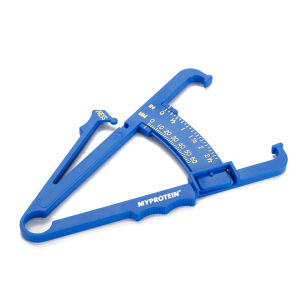 |
Myprotein Skinfold Caliper Body Fat Tester With Instructions 4.59 USD 2.99 GBP 3.79 EUR |
The Ultimate Fat Loss Strategy
The most efficient way and in many cases the only way to reduce your body fat permanently is by combining a well-designed diet with an exercise program that consists of aerobic exercises as well as weight training. It is very important to realize that you need to lose body fat and not muscle mass because the muscles give shape to your body and most important you need them to keep your metabolism high and burn calories throughout the day and night. Your muscles are the furnace that burns your body fat. The more muscles you have, the easier it will be to get and stay lean!
Your fat loss diet should contain between 10 and 30% less calories than your daily caloric need depending on your goals and results. Never go farther than 30% in order to prevent that your metabolism blocks and to prevent that you will lose muscle mass. When you lose more than 5 lbs of body weight per month chances are high that you are losing muscle mass and you should increase your calorie intake to prevent further loss of muscle. Changes in calorie intake should be made gradually in steps of 5 or 10% every couple of weeks.
Your daily calorie intake should consist for 30% of protein, 50-55% of carbohydrates and 15-20% of fat. For a 3000 calorie diet this means that you should eat about 225 g of protein, 375-410 g of carbs and 50-70 g of fat, since protein and carbs contain 4 calories per gram and fat contains 9 calories per gram. You should eat 6 small meals per day (5 for women) about equal in size. Each individual meal should also follow more or less the 30/50/20 rule for protein/carbs/fat as explained above.
As you decrease your calorie intake down to 30% below maintenance level, you should mainly decrease your carbohydrates and maybe also your fat intake, but your protein intake should stay high. Starting from a 3000 calorie maintenance level at 30/50/20 (225 g protein/375 g carbs/70 g fat) you would end up at around 2100 calories somewhere between 40/30/30 (210 g protein/160 g carbs/70 g fat) and 40/40/20 (210 g protein/210 g carbs/50 g fat) depending on what works best for you.
Your protein should come mainly from lean products of animal origin such as low-fat dairy, meat, poultry, fish and egg whites, or from products of vegetable origin such as nuts, beans and soy. Your carbohydrates should come mainly from starchy and fibrous products such as oats, potatoes, yams, rice, pasta, fresh fruit, vegetables, bread, couscous, sugar-free cereals. Your fats should come from vegetable products such as nuts, olives, flaxseeds and sunflower oil, or from fish or a limited number of egg yolks. You avoid products that contain sugar/HFCS, alcohol and large amounts of animal fat. Most of your food should consist of fresh, natural, unprocessed products.
Perform aerobic exercises (jogging, running, treadmill, bicycle, stationary bike, elliptical machine, rowing machine or stairclimber) to stimulate your metabolism and burn extra calories. Do 20 to 60 minutes of aerobic exercises 3 to 6 times per week, keeping your heart rate at 130 (low intensity) to 170 (high intensity) beats per minute. Do your cardio first thing in the morning before breakfast, or right after your weight training workout.
Train with weights (bodybuilding) 3 to 6 times per week for 45-60 minutes to maintain or build extra muscle mass. Do 2 to 4 exercises per muscle group and perform 3 to 4 sets of 10 repetitions for each exercise as explained in the training routines. Increase the poundages and training intensity as you get stronger. Without weight training you will unavoidably lose muscle mass during a calorie restricted diet and consequently suffer from a decreased metabolism which will hinder further and permanent fat loss. Muscle loss is a major cause of rapid body fat regains many people experience after a diet (yo-yo effect).
Any changes in diet or training program should be made gradually in small steps to ensure optimal results and prevent injuries.
Meal and nutrient timing
Although I wrote above that you should aim for 4 to 6 meals of similar size and composition (30/50/20 of protein/carbs/fat) evenly spread over the day, this is probably suboptimal for someone who combines his diet with moderate to high intensity workouts of endurance or weightlifting exercises. For these people, proper timing of nutrient intake may have a substantial additional benefit in helping to lose body fat while building or maintaining muscle mass. The reason for this is rather simple: during intense physical activity the body consumes large amounts of glycogen and during a heavy weightlifting session lots of muscle protein is broken down. During the first few hours after the workout the body recovers by replenishing the glycogen stores and rebuilding muscle proteins by increased glycogen and protein synthesis.
In order to enable and support this accelerated glycogen and protein synthesis sufficient glucose and amino acids, the building blocks of glycogen and protein respectively, need to be available in the blood. This can only be accomplished by sufficient nutrient (carbs and protein) intake shortly before, during and after the workout. By concentrating your carbohydrate and protein intake within this time frame you not only ensure optimal workout recovery and muscle growth but you also substantially reduce the chance that these nutrients are converted into fatty acids and stored as body fat. Every calorie that is stored as glycogen or muscle protein cannot be stored as body fat. As a consequence of eating most of your carbohydrates around your workout, your remaining carbohydrate intake during the rest of the day will be lower, which additionally stimulates your body to use fat as energy source during that period.
To be concrete, for a fat burning workout with moderate to high intensity endurance exercises I would recommend to take one serving of (whey) protein shortly before the workout and a substantial portion of your carbohydrates (up to 50%) within the first couple of hours after the workout. For a very high intensity muscle building workout with weights I would recommend to take one serving of (whey) protein shortly before the workout and another serving or two shortly after the workout. What carbohydrates concerns, I would recommend to take a very substantial portion (up to 70%) of your carbohydrates between the start and three hours after the weight training workout.
It is difficult to put exact numbers on the amounts of protein and carbohydrates that you need to take around your workouts as it differs for each individual and depends from the exact exercise program. But some numbers that you often find in the scientific literature are: 1.2 g of carbs per kg of bodyweight per hour for up to 3 hours after an intense endurance workout, or 0.4 g of protein per kg of bodyweight per hour plus 0.8 g of carbs per kg of bodyweight per hour for up to 3 hours after an intense weight training workout.
As you can see, it is recommended to consume a very substantial portion (up to 70%) of your carbohydrates (during and) after your workouts to replenish your glycogen stores. On the other hand a rather normal portion of your protein is recommended right before or after your workouts to prevent breakdown and enable rebuild and growth of muscle protein. This is because it is important that also during the rest of the day sufficient protein is eaten so that the body has continuously access to sufficient amino acids to uninterruptedly enable protein synthesis 24 hours per day.
Calorie or carbohydrate cycling
One trick that some bodybuilders use to obtain ultra-low body levels is calorie or carb cycling. This basically means that you go low in calories for a few days followed by a few high calorie days. This method is especially useful when you have hit a plateau and you are no longer able to lose additional body fat even though your calorie intake is much below maintenance and you aerobic and weight training are at a high level.
The rationale behind inserting the high calorie/carbohydrate days is to replenish the glycogen supplies in your muscles and to reaccelerate your metabolism. During a prolonged calorie restricted diet your metabolism unavoidable slows down. This is a natural survival mechanism your body uses to cope with periods of low food supplies. A couple of high calorie days may be all that is needed to reaccelerate your metabolism and get you out of the dead end path.
Letting every 3 days of low calories follow by 1 to maximum 3 days of high calories should do the trick. Someone with a maintenance level of 3000 calories per day could for example do cycles of 3 days at 2100 calories of 40/30/30 (210 g protein/160 g carbs/70 g fat) followed by 2 days at 3000 calories of 30/50/20 (225 g protein/375 g carbs/70 g fat). Note that this is just an example and any reasonable variation might fit your personal needs even better.
Summary
The following are the most important aspects for losing body fat:
- Eat fewer calories per day.
- Eat at least 4 small meals per day, about equal in size.
- Eat and drink only products that are low in fat, oil and sugar/HFCS.
- Don't drink alcohol.
- Eat and drink only slowly digesting products that contain lots of fiber, protein, water, lactose and other carbs with a low glycemic index.
- Eat lots of protein.
- Be physically active. Work, walk, exercise (cardiovascular and bodybuilding).
- Concentrate your carb intake in the first 3 hours after intense workouts.
The perfect fat loss day
06:00: wake up
06.30: cardiovascular training (about 45 minutes)
08:00: breakfast
10:00: zero-fat milk protein shake
12:00: lunch
14:00: zero-fat milk protein shake
16:00: dinner
17:00: bodybuilding training (about 45 minutes)
18:00: evening meal
20:00: zero-fat milk protein shake
22:00: bed time
Example
Assume you are a 30 year old, 66 kg (145 lbs) weighing, moderately active female of 170 cm (5"7') with 30% body fat. Your daily caloric need is about 2175 (33 x 66 kg or 15 x 145 lb) calories per day. After a month of diet your daily caloric intake should be about 20% below your daily caloric need, which results in (2177 x 0.80) = 1740 calories per day. You eat about 145 grams of protein per day (1 gram per pound of body weight or 33% of your calories), 205 grams of carbohydrates (47%) and 40 grams of fat (20%).
You drink 3 protein shakes per day, each containing 0.20 liter of zero-fat milk and 15 grams of milk protein powder, giving a total of 20 grams of protein, 11 grams of lactose, 1 gram of fat and 130 calories. Your breakfast, lunch, dinner, and evening meal contain each about 335 calories (21 g protein, 43 g carbs, 9 g fat). Alternatively, if you opt for applying nutrient timing with a high carb consumption post-workout, your breakfast, lunch, dinner, and evening meal could contain 60, 10, 10, and 90 grams of carbs, respectively, and equal amounts of protein (21 g) and fat (9 g).
Each of your meals contains about 21 grams of protein from non-fat meat, non-fat poultry, non-fat fish, egg whites, or non-fat milk products. The carbohydrates should come from the lactose in the milk products, fructose in fresh fruits, and complex carbs in raw vegetables and small quantities of dark bread, brown rice, cereals, pasta, or potatoes. You keep sugar, HFCS and alcohol intake to a minimum and limit your fat and oil consumption. Between the meals you don't eat anything, and only drink zero-calorie drinks such as water and sugar-free tea. After a month, you may decide to lower your daily caloric intake by another 10% (220 calories) down to 1520 calories per day. Once you reach your target weight, you very slowly (over several months) increase you daily calorie intake back up to your new daily caloric need, which might be around 2100 calories.
Diet plan
You may choose to build your own personal diet plan in which you calculate for every meal how many grams of protein, carbs, fat and calories you eat. To accomplish this you could use my TNBB diet plan excel spreadsheet and customize it according to your own needs. You can watch the youtube demo video below or download the high quality video in Windows Media Video (.wmv) or Flash (.swf) format.